Making Study Abroad a Little Less Daunting for Africans

The Study Abroad Research Institute: Making Study Abroad a Little Less Daunting for Africans
African students remain a rare breed in contemporary Japan, despite the rapidinternationalization of the country’s population. Japanese government data show that as ofMay 2019, more than 312,000 foreign students were enrolled in post-secondary education inJapan, but less than 10% of them came from outside East and Southeast Asia, with Africacontributing a mere few thousand to the total. There is certainly room for more Africanstudents in Japan
It is a shame so few African students are in Japan today, considering that they can develop theirprofessional careers in Japan after graduation. Data show that the average annual salary forfull-time workers in Japan in 2019 amounts to more than USD 39,000, with those in highlydemanded IT professions making an average of USD 58,000 a year. Students willing to completetheir postgraduate degrees will further command an average of 23% and 42% premium onthose annual salaries, respectively, for obtaining a master’s and doctoral degrees.But the lack of a significant African diaspora in Japan today, especially when compared to moreestablished host societies like the US, UK, and France, means that it is difficult for Africans toacquire information about the country. Many students in Africa have no acquaintances studyingor living in Japan to personally ask about what it is like to be in Japan, so many are simplyunaware that Japan is a realistic study abroad option. Furthermore, given the often lack ofactive marketing and language barrier on the part of Japanese universities, many Africanstudents will not come across information about available academic programs for them.The Study Abroad Research Institute is Here to Raise Awareness!Given the difficulty for African youths to acquire detailed information about studying in Japan,last year I established the Study Abroad Research Institute (SARI) to help mitigate the situation.SARI, a Tokyo-based non-profit organization run by former and current foreign students inJapanese universities, is dedicated to providing young people across the world, especially inAfrica, information on study abroad opportunities in Japan.SARI, in essence, works as an information platform linking all relevant parties in the studyabroad process. On one hand, it seeks to reach out to more and more African youths directly toraise awareness about the availability of study abroad programs in Japan for them. In the past
SARI, in essence, works as an information platform linking all relevant parties in the study abroad process. On one hand, it seeks to reach out to more and more African youths directly to raise awareness about the availability of study abroad programs in Japan for them. In the past year, SARI has been contacting universities, community colleges, and technical schools across
Anglophone West Africa to schedule a video presentation with their students to directly tell them about the benefits of studying and working in Japan. Students who are interested in studying in Japan are also encouraged to fill in SARI’s sign-up sheet and follow the organization's Facebook and LinkedIn pages, so that they can get more information about Japanese universities taking in foreign students in the near future.
On the other hand, SARI has been contacting admissions offices of hundreds of universities across Japan so that they can provide easy-to-understand information in English about academic programs for which they are actively seeking foreign students. The result is a small database on the SARI website showcasing universities and programs that African youths can directly contact for further information and apply directly if they are interested. While COVID-19 has put the plans of many Japanese universities to take in foreign students on hold for the moment, as the world opens back up after the suppression of the pandemic, SARI will be ready to share even more news about new opportunities for foreign students across many more Japanese universities. While expanding the number of partners, both among admission offices of Japanese
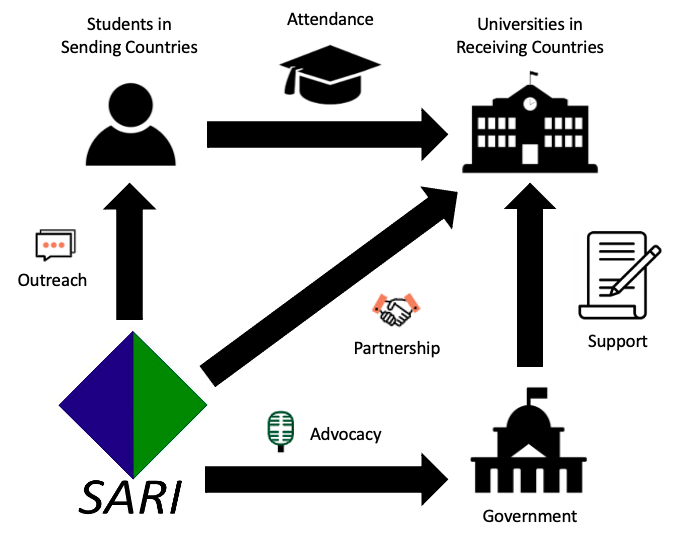
While expanding the number ofpartners, both among admission offices of Japanese universities and organizations in Africa directly in contact with local youths, SARI seeks tobroaden its scope of work to facilitate even more study abroad. One way is to directlywork with government entities that can influence policymaking on internationaleducation, particularly the Japan Student Services Organization (JASSO) andother agencies under the Ministry of Education, Culture, Sports, Science andTechnology (MEXT). The other way is to expand beyond the current focus of Anglophone West Africa, so that more students in more countries can learn about the opportunities available.
But for now, SARI looks forwardto communicating directly with more ambitious African youths looking to taketheir next professional steps in Japan!
Written by: XiaochenSu, a Ph.D. candidate at the University of Tokyo and the Managing Director ofSARI

.jpeg)



























.jpeg)






.png)